

Impact Stories
Real-world challenges spark the most meaningful innovation. When engineering meets human-centered design, ideas start with people—not just problems—making critical thinking personal and problem-solving purposeful. That is the focus of our partnership with Olivet Nazarene University’s Walker School of STEM, where students design solutions rooted in empathy and lived experience.
This year, two interdisciplinary engineering student teams partnered with Devices 4 the Disabled on a two-semester capstone project, tackling mobility-related challenges faced by individuals who rely on walkers and wheelchairs every day. Rather than starting with a design on paper, the teams began with a deeper question: How can this work better for the person using it?
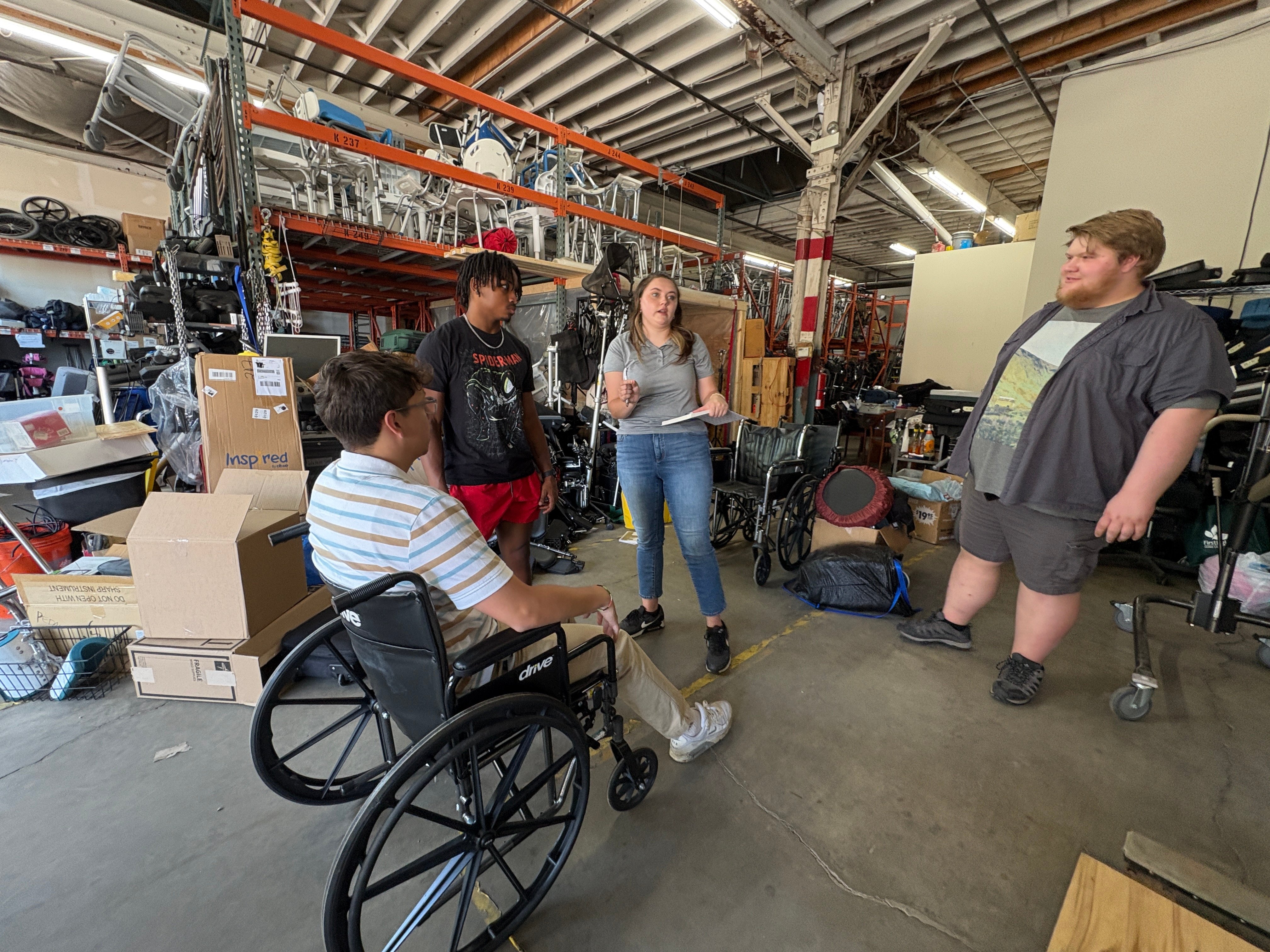
To answer that question, the students visited D4D to learn more about our mission, explore a wide range of mobility equipment, and see firsthand how individuals use it in daily life. Experiencing how people move, transfer, and navigate their environments, gave the teams valuable insights into the real challenges and opportunities that shape effective mobility solutions.
One team, working with faculty advisor Dr. Aram Agajanian, Ph.D., is addressing a common but frustrating problem: when a walker moves out of reach, leaving the user unable to safely retrieve it. Their design prioritizes simplicity, safety, and independence—ensuring the solution works for people with limited strength or mobility. The other team, advised by Dr. Soek Lew, Ph.D., is creating a wheelchair lift system that safely assist a person seated in a manual wheelchair, balancing biomechanics, user safety, caregiver needs, and the realities of daily use. Their impressive designs merge engineering precision with human-centered design.
Throughout the research and design phase, empathy guided the teams' decisions. Students considered not only how a solution functions, but how it feels to use—how it supports independence, reduces frustration, fits into daily routines, and improves a person's life. These projects go beyond theory, drawing directly from lived experience and real needs, with a commitment to making everyday mobility better for those who rely on the equipment.
The teams have completed their research and design phases and are now building prototypes. As the teams presented their projects with end-of-semester progress to their professors and peers, one professor remarked, "This is extremely meaningful work—it makes you wonder why no one has done it before." His words reinforce the value of these projects and highlight how they have the potential to create tangible impact.
This partnership shows what happens when education meets community and engineering meets empathy: possibility expands—for students and for the people they aim to serve. We are inspired by the creativity, care, and responsibility these students bring to their work—ensuring that purpose drives the process. And, we are excited to see their innovation take shape and see these projects evolve over the coming months.
Stay tuned. There’s more to come.